The AI System I Use Every Day (And How You Could Build One Too)

How this started
I didn’t set out to build an “AI ecosystem.” That sounds like something a vendor would say. What actually happened is more boring: I had too many meetings, too many status updates, and too many tools that promised to help and mostly added noise.
So I started small. I automated one thing I did every morning: checking my calendar and figuring out what needed attention that day. That single habit grew into something bigger than I expected.
A year later, I have a set of connected services that work for me around the clock. Not because I planned the whole thing up front, but because each small automation solved a real annoyance, and the pieces slowly started talking to each other.
What it looks like today
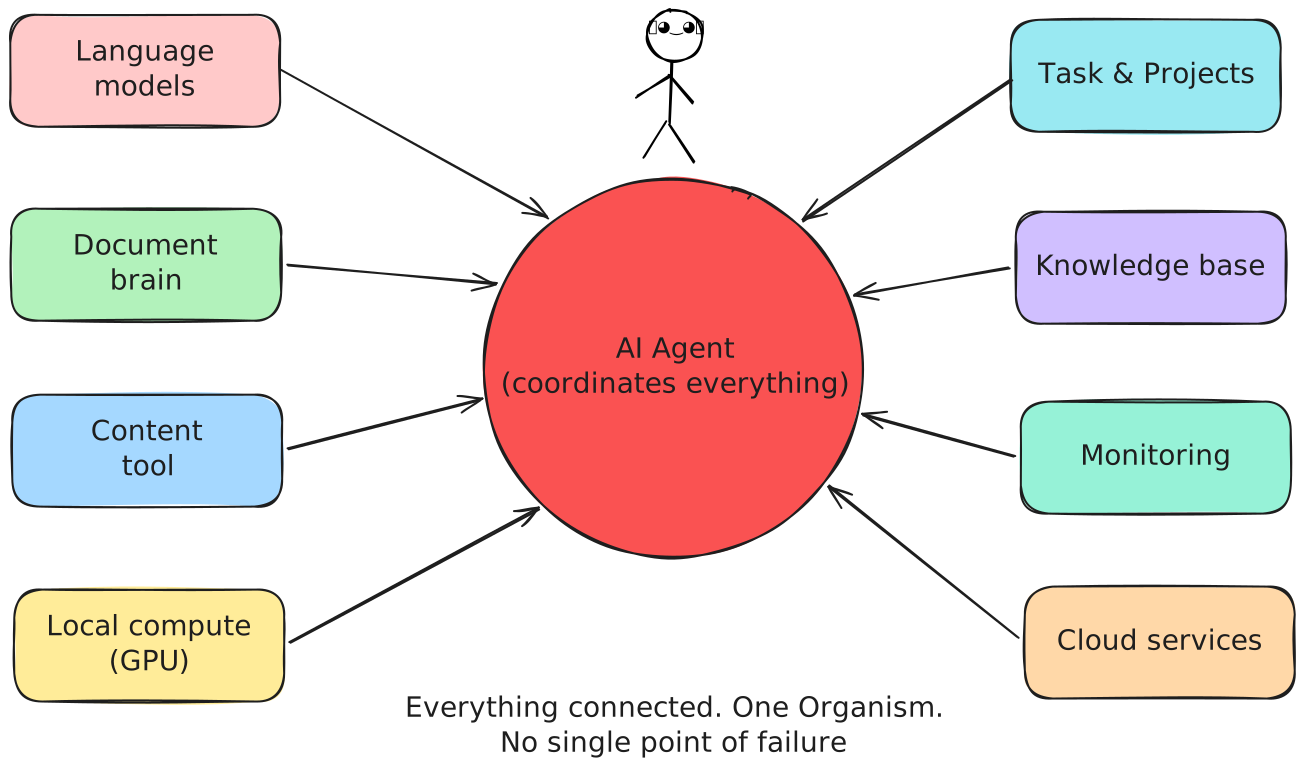
I think of it as one organism rather than a stack of tools. Everything shares context, so nothing lives in a silo:
| What it is | What it does for me |
|---|---|
| An AI agent that coordinates everything | My digital right hand. It knows my calendar, my documents, my boards, my files. |
| Language models | The thinking engine behind the writing, analysis, and reasoning. |
| A document brain | Files arrive in any format; it converts, extracts, and organizes them. |
| Task and project management | Keeps the team aligned without me chasing anyone. |
| A knowledge base | Notes and ideas compound over time instead of vanishing. |
| Content tools | Takes a rough idea and carries it through to a published post. |
| Monitoring | Watches everything quietly, so I don’t have to. |
Each piece is simple on its own. Together they behave like a small team that never sleeps.
The center of it: an agent that works the way I work
The most useful part is not any single tool. It’s the agent I trained to work the way I work.
I called him Jarvis, because naming things makes them easier to talk to. He’s connected to my calendars, documents, task boards, and publishing tools. He doesn’t wait to be asked — he handles what he knows I’ll need.
Every morning I wake up to a briefing prepared while I slept: what’s on the calendar, what changed, what needs a decision. When I’m in a meeting, the follow-up is already drafted. When a report has to go out, the data is gathered before I ask.
The division of labor is simple: the machine handles the volume, and I handle the judgment.
What actually changed
These are the areas where I can measure the difference:
Daily operations. One clear summary every morning instead of five tabs and three tools. Calendar, events, coordination.
Reports and documentation. Project status reports, meeting notes, technical docs. What used to take an afternoon now takes minutes: the agent gathers and drafts, I review and decide.
Document processing. Files in every format, arriving constantly. The system converts, extracts, and files them automatically. No more manual data entry.
Content. Blog posts, social media, visuals — in two languages, with a consistent voice. I review everything before it ships, but the heavy lifting is done.
Financial tracking. We’re building automated control of business and personal finances: categorization, tracking, scheduled reporting.
Staying current. This is the part I value most. I’m not reading about AI — I’m using it daily in real operations. Every project teaches us something new.
The architecture, roughly
Here’s how the pieces connect. I drew it by hand, because the system may be automated but the thinking behind it is still very human.
What I’d tell someone starting out
If you’re curious about building something like this, here’s what I learned:
- Start with one annoying task. Not a grand vision. Pick the thing you do every day that you hate. Automate that one.
- Let it compound. Each automation seems small alone. They start connecting on their own once you have a few.
- Keep the human in the loop. The machine drafts, gathers, and reminds. You decide. That division is what makes it sustainable.
- You don’t need to be a developer. The tools are more accessible than you think. I learned most of this by doing.
This is not about replacing anyone. It’s about getting the repetitive work done so the interesting work gets the attention it deserves.
If you’re curious about any of this, I’m happy to talk — whether you want to build something similar or just want to see how it works in practice.