Catalyst Poster Creator: Decentralized Web-to-Print Architecture for High-Traffic Events
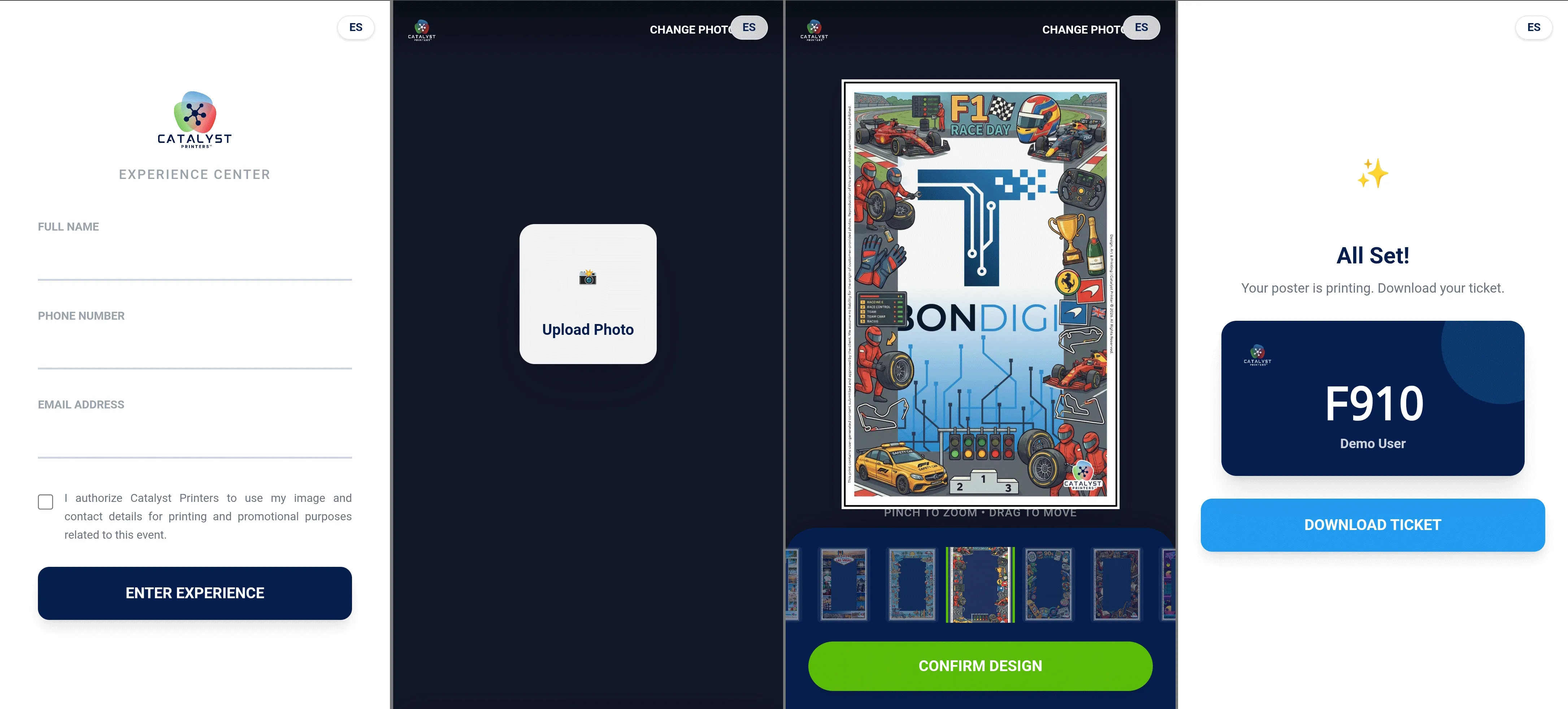
The Operational Challenge
In the context of massive corporate events, promotional brand activations based on custom-printed products usually fail at the exact same friction point: endless physical queues. The traditional pipeline—where a customer dictates preferences to a dedicated designer who then manually manipulates a file in Illustrator/Corel before sending it to the printer—simply does not scale.
The technical mandate for this project was to engineer an architecture capable of absorbing multiple, concurrent graphic personalization requests (up to hundreds of simultaneous users). This required transforming attendees’ own mobile phones into active design terminals, guaranteeing that submitted jobs were piped directly into industrial UV printers entirely without technical supervision.
Technical Architecture & System Integration
The infrastructure implements a Hybrid Edge/Cloud Architecture leveraging a Python 3.10+ (Flask) backend combined with an offline synchronization daemon to maintain maximum database reliability on the showroom floor.
Mobile Client UI
QR Code / TailwindCentral Flask Server
Pillow / ReportLabSQLite Database
Orders & Batch StateLocal Sync Agent
Automated PythonIndustrial RIP Folder
Catalyst Aventra BedMobile Client UI
QR Code / TailwindCentral Flask Server
Pillow / ReportLabSQLite Database
Orders & Batch StateIndustrial RIP Folder
Catalyst Aventra BedLocal Sync Agent
Automated Python1. Mobile-First Single Page Application (SPA)
The frontend was engineered utilizing clean HTML5, TailwindCSS, and Alpine.js. To prevent standard mobile browser scaling anomalies during multi-touch canvas actions, the layout uses an absolute fixed viewport structure (position: fixed). The UI enforces a fluid pipeline: Data Entry -> Native File Picker -> Visual Overlay Frame Engine (Interact.js) -> Unique Electronic Ticket Token Generation.
2. High-Performance Image Manipulation and PDF Compilation
When the user submits their design, the core Flask engine takes over.
- Raster Processing: Utilizing the
Pillowlibrary, the chosen photograph and form data are normalized, scaled, and embedded within the pre-designed poster’s placeholders at 300 DPI. - Vector Encapsulation: Through
ReportLab, the backend wraps this flattened image data directly into a prepress-valid PDF file, strictly maintaining correct color profiles and standard physical dimensions, ready for the print bed.
3. Smart Batch Nesting & Automated RIP Injection
Because industrial UV hardware like the Catalyst Aventra is built to maximize the amount of physical items produced per printing cycle, the system fundamentally avoids printing single posters inefficiently.
- Instead, jobs are reliably queued within the centralized
SQLitedatabase. - An automated Daemon script—operating quietly in the background on the local machine physically connected to the printer—polls the cloud database every N seconds.
- Once an optimal print batch multiple is reached (e.g., 4 posters), this agent downloads the generated cloud PDFs, stitches them into a unified production block, and deposits them into the local Hot Folder, instantly activating the machine’s industrial print heads.
Field Validation: Live at APA 2026, Las Vegas
We deployed this infrastructure live at the Awards and Personalization Association (APA) 2026 event. The system entirely disrupted the standard UV printing booth dynamic. Rather than assigning dedicated technical staff to manually process incoming Photoshop/Illustrator files upon request, visitors interacted with physical QR codes and independently completed the design phase in seconds. Meanwhile, the sales staff remained fully focused on engaging with clients and selling hardware.
Current Sprint: Continuous Optimization
- Asynchronous Payload Management (Celery/Redis): For our next major event, where we anticipate bursts exceeding 500 requests per minute, we are refactoring the current synchronous Flask save bottleneck. By migrating the heavy image processing tasks to a dedicated Celery background queue, we guarantee instantaneous server response to the mobile client, even under severe computational load.
Strategic Business Outcomes
This successful deployment validated three foundational business growth metrics in live-hardware Web-to-Print operations:
- Complexity Delegation: The operational overhead and technical prepress time were completely and frictionlessly offloaded directly to the end user.
- Zero-Wait Parallel Processing: By decentralizing the data entry to personal mobile devices, the process was transformed from a slow 1-to-1 bottleneck into a massively parallel Many-to-1 asynchronous flow, eliminating lines entirely.
- Automated Uninterrupted Production: The “Smart Batch Nesting” engine ensured the hardware operated continuously at 100% capacity. This maximized both machine ROI and the sheer volume of high-quality, customized promotional souvenirs we successfully placed directly into the hands of prospective clients.