The 45-Minute Huddle and the Trap of False Transparency
August 19, 2026
The 45-Minute Huddle and the Trap of False Transparency
A management fable inspired by the Rockefeller Habits from “Scaling Up” (Verne Harnish).
When synchronization turns into control
A good part of Verne Harnish’s Scaling Up is about what he calls the Execution Rhythm, and its most humble tool is also the easiest to corrupt: the Daily Huddle, that stand-up meeting of seven to ten minutes meant to align the day, review the tactical numbers, and clear one bottleneck. It is not another meeting. It is the pulse of the morning.
The problem is that the word “meeting” awakens an old instinct in many executives: convene, present, give orders. When the tool falls into the hands of centralized leadership, the huddle stops being a spark that lights the operation and becomes a shackle. This fable is about exactly that, and about what it costs to win the tool back.
The story
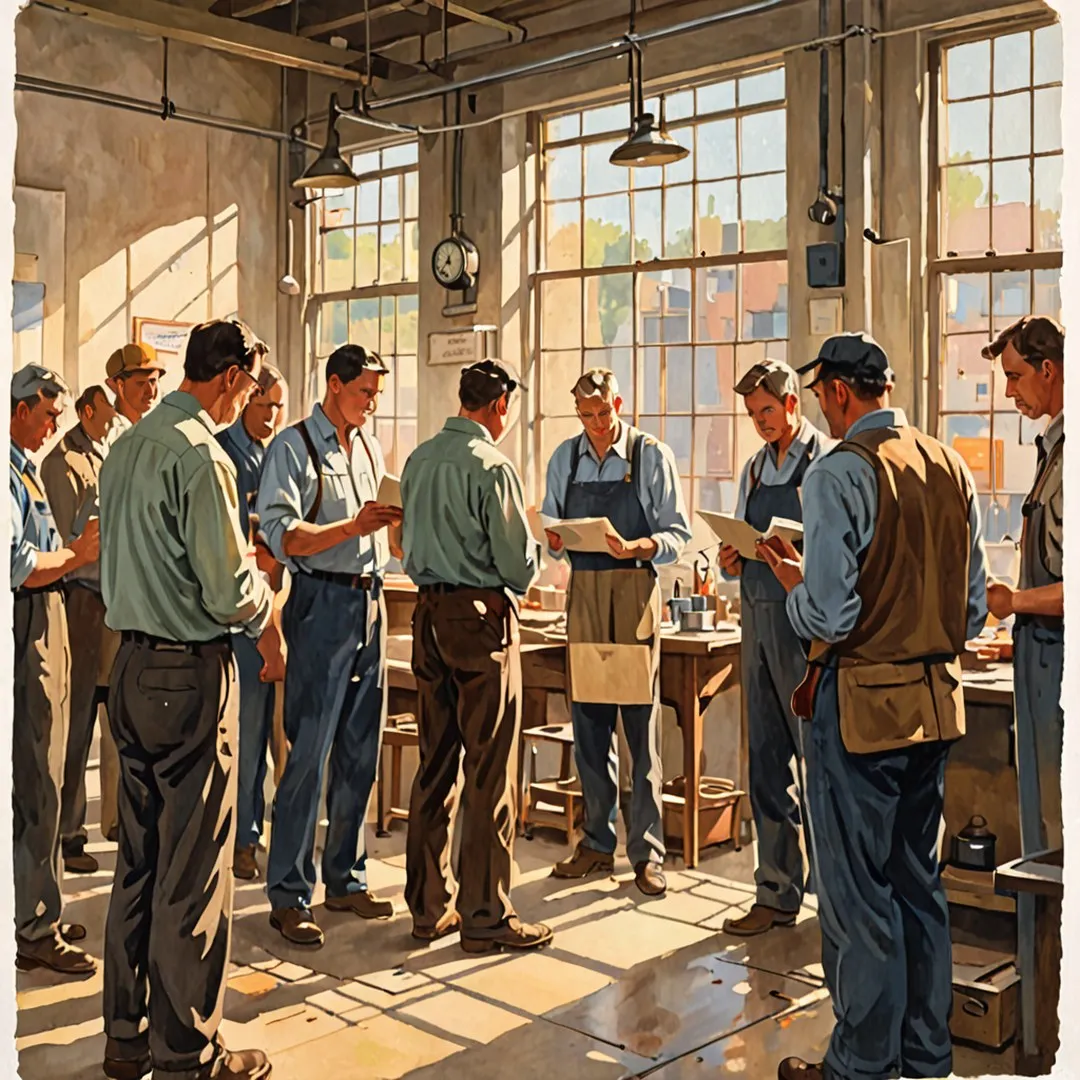
At exactly eight o’clock, the bell at Axion Systems marked the start of the mandatory ritual. The entire organization, from design engineers and software developers to assembly technicians and shop-floor operators, was required to gather in the main lobby.
On paper, the company claimed to be implementing Scaling Up. In practice, that meeting ran over forty-five minutes. Leadership reviewed every daily task point by point, discussed raw revenue and loss figures, and dictated direct orders to each department.
The stated intent was “complete transparency.” The actual effect was something else.
Showing raw balance sheets to shop-floor staff did not create understanding. It created rumors. Technicians nervously discussed sales figures and export costs without understanding the margin structure or the company’s reinvestment commitments. And there was something worse: no team started work before 8:45. Nobody set up their station or got ahead on fixing issues, because everyone knew nothing moved until leadership spoke. The staff had learned to wait for orders with a polite, fake smile.
In a forty-person company, forty-five minutes every morning meant about thirty productive hours evaporating each day into redundant speeches.
Carolina, the newly appointed Director of Operations after running high-precision industrial plants, watched the ritual through her first week. After the fifth huddle, she asked to speak privately with the Managing Partner.
“We have a problem with our morning meeting,” Carolina said, without preamble. “Instead of being the engine of the day, it is a shackle tied to a rock. We are burning over six hundred hours a month for forty people to hear instructions that only concern four. And sharing raw financial figures on the shop floor without context only creates distortion.”
“Harnish’s book says we should meet every day to stay aligned, and that transparency drives commitment,” the Partner replied, crossing his arms.
“The book advocates tactical synchronization, not assembly-style micromanagement,” Carolina said calmly. “Transparency does not mean throwing numbers at people who have no levers to move them. It means giving each work cell the exact data it needs to make decisions on its own. If we do not change this, we will keep paying in slowness and in damaged morale.”
With the backing of the leadership, Carolina made three changes.
She eliminated the company-wide assembly. At eight, each unit, Mechanical Assembly, Software Integration, Technical Support, and Quality Control, met standing in its own workspace with its direct team lead. Three questions and zero speeches: what win closed yesterday, what is today’s non-negotiable priority, and where is a bottleneck that needs help. At the seven-minute mark a bell rang and everyone started work.
In-depth financial reporting moved to the weekly tactical review with the unit leaders. On the shop floor she installed visual boards with the metrics the team actually controlled: assembly cycle time, on-time delivery rate, and first-pass yield.
The impact was immediate. Within a month the passive waiting disappeared. Technicians arrived with their stations prepped, flagged bottlenecks in seconds, and solved them among themselves. The forty-five-minute meeting shrank into a concentrated seven-minute burst that lit up the operation.
What a leader should take from this
A huddle is for synchronizing, not for administering. If a daily meeting lasts more than ten minutes or requires people to sit, it is not a huddle, it is a committee that destroys agility. The duration is not a whim: it is the sign that the space is serving a different purpose than the one it should. Once I stopped asking for shorter meetings and started asking what leadership was doing in them that did not belong, the answer was almost always that someone was using everyone’s time to manage their own agenda.
Real transparency is contextual. Sharing financial data without the training to interpret it does not build trust, it builds anxiety and gossip. Every level of the organization needs the metrics it can actually act on. This is not about hiding information. It is about delivering it where it does useful work. Giving an operator the company’s gross margin without explaining what they can do with that number is noise, not transparency.
Disguised micromanagement kills initiative. When leadership uses alignment routines to dictate individual tasks, it trains the team in absolute passivity. Nobody moves until told, and the whole operation waits. The goal of a good system is a team that operates on its own without needing daily permission. If people only work after you speak, the problem is not the people, it is the system.
The question that remains
If you disappeared from the huddle for a week, would your team start the same way, or would everything pause waiting for your instructions?
Fable inspired by the Rockefeller Habits from “Scaling Up” by Verne Harnish.